
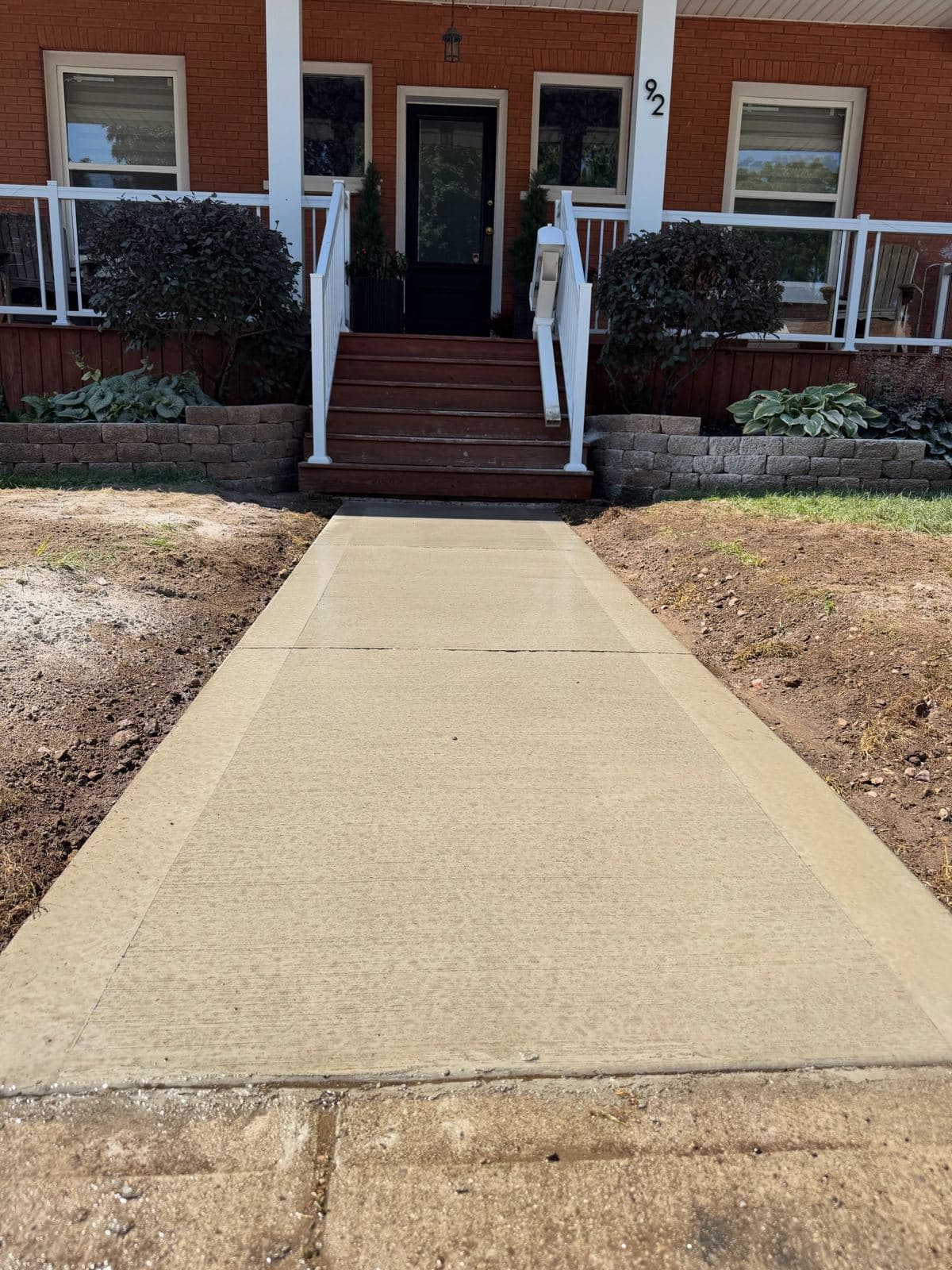
Shrinkage, and why it is unavoidable
Concrete contains more water than the chemical reaction needs, because otherwise you could not place it. As that extra water leaves, the slab shrinks.
A slab is restrained while it shrinks: by friction against the base underneath, by whatever it is tied to at the edges, by its own reinforcement. Something that wants to get smaller but is being held cannot do it evenly, so it relieves the stress by cracking. That is not a defect, it is the material behaving exactly as it always does.
Control joints: choosing where the crack goes
A control joint is a deliberate line of weakness sawn into the slab, normally to about a quarter of its depth. It is the thinnest section, so it is where the shrinkage stress concentrates, so it is where the crack forms.
Get the depth wrong, cut too late, or space the joints too far apart, and the concrete cracks where it wants to instead. That is the wandering crack across the middle of a driveway that people assume means bad concrete. The concrete was fine. Nobody gave it anywhere to go.
Reinforcement: keeping the crack from becoming a step
Steel does not stop cracking. What it does is hold the two faces of a crack tightly together so it stays a hairline you can barely see instead of opening up and letting the sides move independently.
That is the difference between a slab with a fine line in it and a slab with a step in it that catches a shovel. The step version is what people mean when they say a driveway is shot.
The cracks that are not shrinkage, and are the expensive kind
Settlement cracking happens when the ground under a section of slab gives way, usually because the base was never compacted properly or because water is getting under it and freezing. These are the cracks with a height difference across them, and they get worse every year.
Frost heave lifts a section and drops it again. Root intrusion does the same thing more slowly and locally, and you can spot it because the crack runs in an arc.
None of these are fixed by better concrete. They are fixed by excavating properly, building a base that drains and compacting it in lifts. Which is why, when you are comparing quotes, the interesting part is not the concrete spec. It is what the contractor says about what happens before the truck shows up.
Reading your own concrete
Fine, straight cracking along a sawn joint is the system working exactly as designed. Nothing to do.
A random hairline crack across a slab with no height difference either side is shrinkage that found its own path, usually because a joint was too far away or cut too shallow. Cosmetic. Worth sealing so water and salt stay out of it, not worth replacing the slab over.
A crack with a height difference across it, where you can catch a shoe or a shovel on the lip, means the ground under one side has moved. That one is structural and it will keep going.
A crack that runs in an arc, usually near a mature tree, is a root. It will not stop, because the root will not stop.
Surface flaking, where the top few millimetres come away in sheets, is usually salt damage on concrete that was unsealed or under-cured. The slab underneath is often perfectly sound.
Three things that make it worse, all free to avoid
Road salt on residential concrete, particularly through the first winter. New concrete has not fully cured and salt is hard on it. Sand for traction that first year if you can.
Water aimed at the slab. A downspout emptying onto a driveway, or a walkway pitched back toward the house, is delivering the exact thing that causes heave. Moving a downspout extension is the cheapest concrete repair there is.
Parking something much heavier than the slab was built for. Four inches is right for cars. It is not right for a loaded tandem trailer that lives there.
What to expect from a good job
Straight, sawn joints at sensible spacing. Fine cracking, if any, in those joints. No height difference across anything. Water running off the slab rather than sitting on it or under it.
That is what we warranty. Our residential work carries a written ten year structural warranty, which covers the structure we built: base, slab and reinforcement.
Written by the crew at Ironground Construction Ltd., a concrete contractor in Kitchener. We self-perform our own forming, reinforcing steel, placing and finishing. If you want a second opinion on a job, the site visit is free and we will tell you straight if you do not need the work.