
The structural difference, which drives everything else
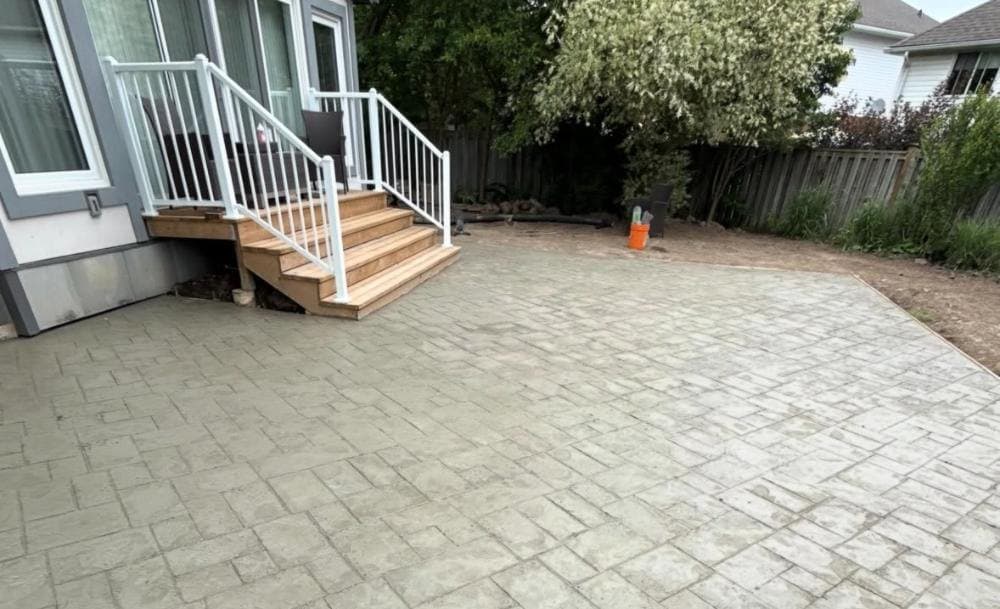
A stamped patio is one continuous reinforced slab with a pattern pressed into the surface while the concrete is still green. The colour is in the mix and worked into the surface, not painted on.
A paver patio is hundreds of individual manufactured units set on a compacted base and a bedding layer, with jointing sand swept between them.
Every difference below comes out of that one fact.
Where concrete wins
Nothing moves relative to anything else, because it is all one piece. No individual unit settles, no edge lifts, no trip hazard develops between two units.
Nothing grows between the joints, because there are no joints to grow in. Anyone who has had a paver patio for a decade has pulled weeds out of it or re-sanded it, usually both.
No re-levelling. Paver fields want lifting and re-bedding periodically, particularly around the edges and anywhere a vehicle crosses them.
It is generally the cheaper of the two over the life of the surface, once you count the maintenance rather than just the install.
Where pavers win, honestly
You can lift one and replace it. If a tree root comes up under a corner, or a utility has to be dug up, or you want to change the shape in five years, pavers can be taken apart and put back. Concrete cannot. That is a real advantage and it is the main one.
They do not crack, because they are already in pieces. Concrete shrinks as it cures and it cracks somewhere: a good job puts that crack in a sawn joint where it is invisible, but the honest version is that concrete cracks and pavers do not.
There are looks you can only get with real units, particularly with natural stone, and on some heritage properties that is the right call.
How each one ages through an Ontario winter
Both are fine if they are built on a proper base and both fail if they are not. Freeze-thaw and road salt are the two things working on them.
Concrete wants sealing to keep salt out of the surface, and decorative concrete wants resealing on a cycle. Neglect it for a decade on a surface that gets salted and you will get flaking. Pavers do not care about salt in the same way, but the jointing sand washes out and the bedding layer is what heaves.
In both cases the failure people actually experience traces back to base and drainage, not to the surface they chose.
Exposed aggregate, the option people forget
There is a third answer and it suits a lot of yards better than either of the first two. Exposed aggregate is poured concrete with the surface washed back to reveal the stone in the mix. You get real texture and real stone colour without a stamped pattern that is trying to imitate something else.
It hides surface wear better than a smooth finish, it is excellent underfoot, and it does not date the way a strong stamped pattern can. Where it is less forgiving is barefoot around a pool, and it is harder to sweep clean than a smooth slab.
How to judge a contractor's stamped work
Ask for photos of a job three or four years old rather than the day it was sealed. Anything looks good the afternoon it is finished. What you want to see is how the colour has held and whether the joints have stayed tight.
Look at where the pattern meets an edge or a curve. Sloppy stamping shows at the boundaries, where the mats have been forced rather than planned, and you get a squashed or stretched pattern down one side.
Look for the control joints. On good stamped work they are cut into the pattern lines so you have to hunt for them. On rushed work they run straight across the design.
Ask who is doing the stamping. It is a short window and it is skilled, and a crew that subs out finishing has handed the most important hour of the job to somebody else.
Cost over the life, not on the day
We do not publish prices, but the shape of the comparison is worth understanding before you start collecting quotes.
Pavers and stamped concrete usually land close enough on installation that it is not the deciding factor. The gap opens over the following twenty years, and it opens in maintenance: re-sanding joints, re-levelling settled areas, pulling weeds, replacing units that have spalled. Concrete's maintenance is resealing, which is a job you can do yourself in an afternoon.
The place concrete costs you more is if you change your mind. Altering a poured patio means breaking it out. That is the real trade you are making.
How we would decide
If it is a back yard patio you intend to keep as it is, and you would rather not do maintenance, stamped concrete. That is most of the patios we pour.
If the layout is likely to change, if there is a mature tree that is going to keep pushing, if there are services under it that will need digging up, or if the property calls for real stone, pavers are the better answer and we will tell you that at the site visit rather than sell you a pour you will regret.
Written by the crew at Ironground Construction Ltd., a concrete contractor in Kitchener. We self-perform our own forming, reinforcing steel, placing and finishing. If you want a second opinion on a job, the site visit is free and we will tell you straight if you do not need the work.