
The standard, and when to go past it
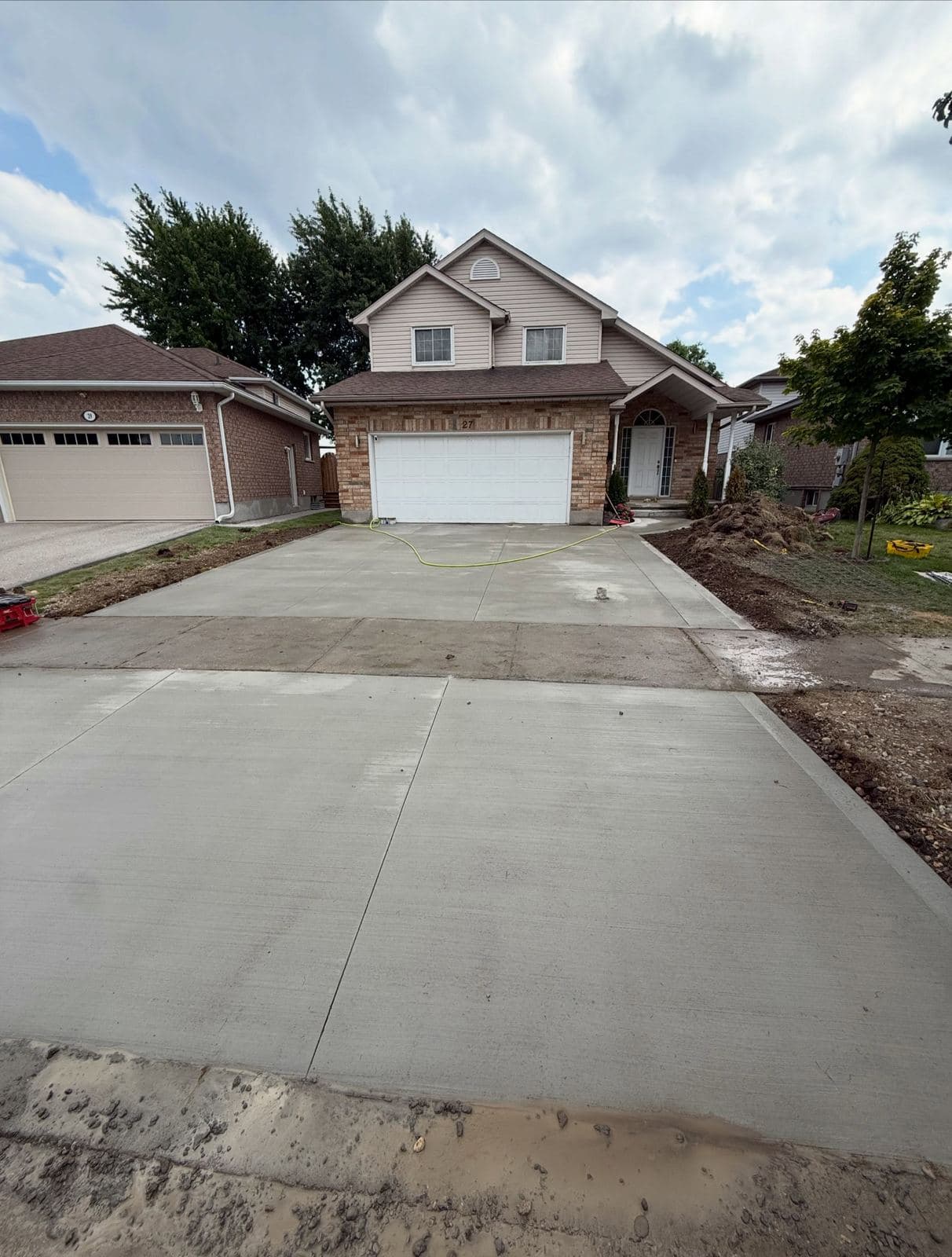
A residential driveway carrying cars and light trucks is normally poured at four inches. That is the number every contractor in Ontario will quote you and it is the right number for most houses.
Go to five or six inches when something heavier is involved: an RV, a loaded work truck, a trailer that will sit parked for months, or a section that a delivery truck has to cross to get to the back of the property. Thickness is cheap compared to the rest of the job, so if you know a heavy vehicle is in your future, say so at the quote rather than after.
Why thickness is not the thing that saves you
Concrete is extraordinarily strong in compression. Almost no residential driveway has ever failed because a car was too heavy for four inches of concrete.
Driveways fail because the ground under them moved. Water gets into a poorly drained base, freezes, expands about nine percent, and lifts the slab. It does that every winter until a section has shifted relative to its neighbour. At that point you have a step, and you do not have a thickness problem, you have a base problem. Six inches of concrete on a bad base fails the same way four inches does, just with more expensive debris.
If you are comparing quotes and one contractor is talking about slab thickness while the other is talking about excavation depth, granular base and compaction in lifts, the second one is telling you where their money goes.
What actually decides how long it lasts
Excavation to ground that will carry load, rather than pouring on top of old fill. Granular base built back up and compacted in lifts rather than dumped full depth and rolled on top, because compaction only travels so far down. Drainage designed so water can get out from under the slab instead of freezing under it. Reinforcement sized to the load. Control joints cut to the right depth and spacing so the shrinkage cracking happens in a sawn line instead of across the middle.
That is the list. Thickness is on it, near the bottom.
The frost question, for anything structural
Flatwork like a driveway does not need footings. Anything structural does, and in this part of southern Ontario the Ontario Building Code sets the minimum depth to the underside of the footing at 1.2 metres, about four feet, for a heated foundation on well drained soil (OBC Table 9.12.2.2). Unheated structures are treated differently and often need to go deeper.
So if your driveway job also involves a garage pad, a porch, or piers for a deck, those are a different rule from the flatwork beside them.
Mesh, bar or fibre
Welded wire mesh is the most common reinforcement in residential flatwork. It works, on one condition: it has to sit up in the slab rather than on the ground. Mesh lying on the base is doing nothing at all, because it is below the place where the tension is. It gets held up on chairs, or it gets lifted into position as the pour goes in, and whether a crew actually does that is one of the real differences between two quotes that look identical on paper.
Rebar is stiffer, heavier and easier to keep in position, and it is what we use where the load justifies it: thicker slabs, anything a heavy vehicle will sit on, and structural work.
Fibre in the mix is a different tool. It helps control the fine shrinkage cracking that happens in the first day while the concrete is still plastic. It is not a substitute for mesh or bar, and anybody selling it as one is selling you something.
Where the driveway meets the road
The apron, the piece between your driveway and the street, takes more abuse than the rest of the slab combined. It gets the plow, it gets the road salt, and it carries every vehicle at the point where they turn.
It also usually sits partly on municipal land, which means changing it can involve the city even when replacing the rest of the driveway does not. If a quote stops short of the road, ask why, because a new driveway meeting a failed apron looks unfinished and the apron will keep breaking up.
What to actually ask a contractor
How deep are you excavating, and what are you putting back. If the answer does not include a granular depth and the word compaction, keep asking.
Are you compacting in lifts, and how many. A single dump compacted from the surface is not compacted at the bottom of it.
What reinforcement, and how are you keeping it off the ground.
Where are the control joints going, how deep are you cutting them, and how soon after the pour. Joints cut too late have already lost the race.
Is sealing included, and how often will I need to reseal.
What is the warranty, in writing, and what does it actually cover.
Written by the crew at Ironground Construction Ltd., a concrete contractor in Kitchener. We self-perform our own forming, reinforcing steel, placing and finishing. If you want a second opinion on a job, the site visit is free and we will tell you straight if you do not need the work.